CUBA 2.0 · HOUSING

Housing for Every Family.

Two million homes in eight years. Modular, expandable and built to last, with private property respected and no property tax on residential homes.

Build fast. Build to grow. Give every family clear title.

CUBA 2.0 target
2,000,000
homes in 8 years

About 250,000 a year, against an official deficit of 831,151 homes.

Cuba is short 831,151 homes by the government’s own count: 399,361 that need to be built and 431,790 that need to be rehabilitated. The deficit keeps growing, from 805,583 in March 2025 to 831,151 today, while 35% of the 4.1 million homes on the island are officially in regular or bad condition.
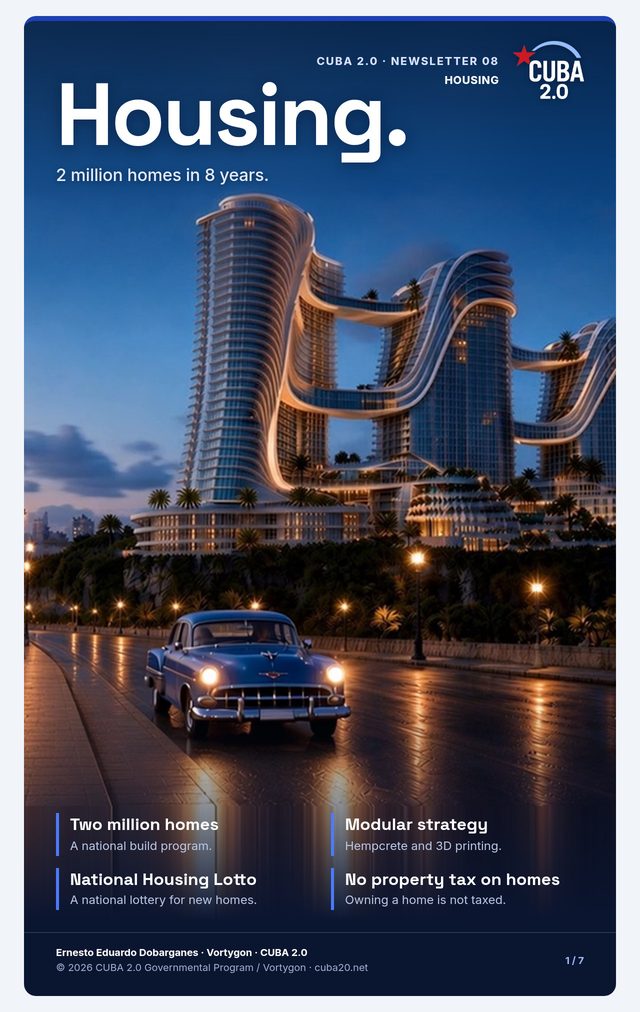
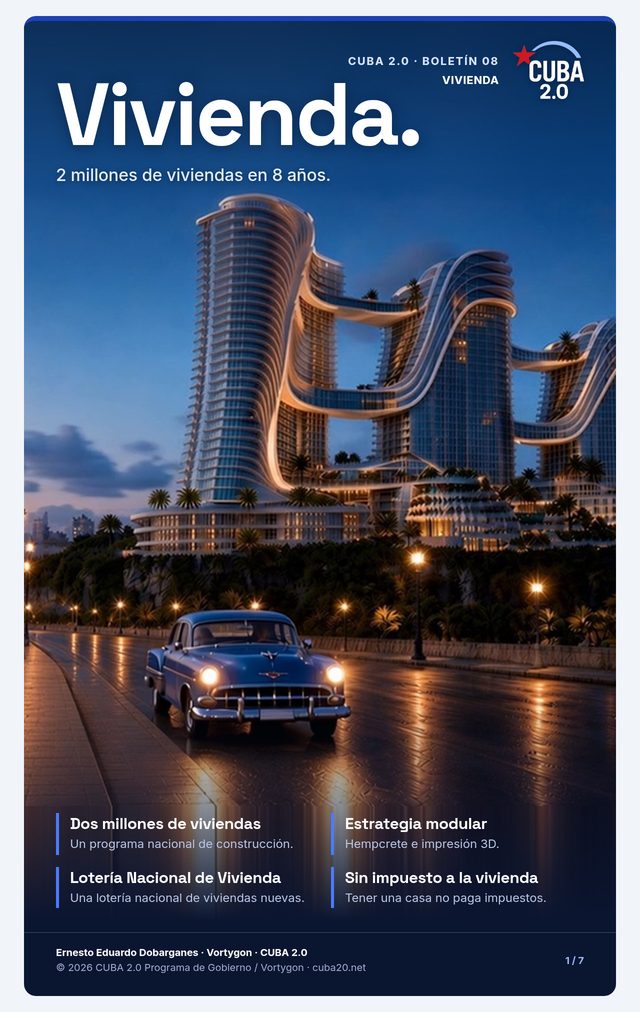
Curving residential towers lit at blue hour above the Malecón in Havana, with a classic blue car on the seafront road, CUBA 2.0 housing plan for Cuba
CUBA 2.0 Housing: two million homes in eight years.
831,151
Official housing deficit: 399,361 homes to build and 431,790 to rehabilitate.
Micons, Cubadebate, Nov 8, 2026
5,493
Homes completed in 2025, 83% below 2021. The state finished only about 17% of its own plan (1,791 of 10,795).
ONEI
35%
Of the 4.1 million homes are officially in regular or bad condition, about 1.4 million dwellings.
Official figures
2,000,000
Homes in 8 years is the CUBA 2.0 target, about 250,000 a year.
CUBA 2.0 target
01 / 05 · THE COMMITMENT

A safe home for every family.

CUBA 2.0 treats housing as a foundation of reconstruction. Every family should have a safe, expandable home under clear title that produces its own power, returns biological waste to local animal farms, and grows with the family. The first years aren’t about luxury. They’re about getting families out of buildings that are collapsing and putting new homes where food can be grown close to the table.
Single-story white and concrete modular house with solar panels on the roof, glass doors onto a covered porch with a black railing, a softly lit and simply furnished interior, and a tropical garden with palm trees, CUBA 2.0 housing plan for Cuba
A modular, expandable home that produces its own power, with food grown close to the table.
02 / 05 · THE REAL SITUATION

The deficit keeps growing.

Cuba’s 2019 Housing Policy promised 527,000 new homes and 402,000 rehabilitations in a decade, yet the deficit has grown from 805,583 in March 2025 to 831,151 today. Completions fell from 32,874 in 2021 to 5,493 in 2025. The state itself finished only 1,791 units last year, and families built two-thirds of what was finished, while 40,191 self-built homes sat paralyzed. Rebar output in 2025 was a fifth of the year before.

Officially, 65% of homes are in good condition. An independent survey by the Cuban Observatory of Human Rights found only 18% of respondents said their home was in good condition, and 7% said they live at risk of collapse. In Havana, press reports cite a government acknowledgment of about 1,000 partial or total collapses a year.

Sources: Micons via Cubadebate (Nov 8, 2026); ONEI; Cuban Observatory of Human Rights; press reports.

03 / 05 · MODULAR STRATEGY

Built fast. Built to grow.

Costs for Cuba will be engineered, tested and certified locally. The point is speed and quality, and a house that can grow without being torn down.
A crane lowers a prefabricated room module onto a concrete slab beside a finished modular house while two workers guide it, CUBA 2.0 housing plan for Cuba
A first module can grow into a family house on the same plot.

The philosophy: self-sufficient, resilient, expandable

CUBA 2.0 homes won’t depend on a distant grid or a distant warehouse. Each home:

1

Its own power.

Each home produces its own electricity.

2

Waste back to the farm.

Each home collects biological waste for local animal farms.

3

Expandable.

A first module can grow into a family house on the same plot.

4

A community farm mesh.

The household produces food as well as consumes it.

04 / 05 · HOUSING COMPARED

Housing compared

A. Price per m² (USD)

CityCenterOutside center
Havanaabout $223 citywide mediann/a
Santo Domingo$2,469$1,346
Guatemala City$2,039$1,091
San José, CR$2,715$2,065
Bogotá$2,794$2,157
Kingston$2,894$2,043
Panama City$3,112$1,749
Mexico City$3,603$2,109
San Juan$7,332$4,616
Miami$7,566$3,828

B. Rent for a central 1-bedroom compared with monthly pay

CityRent (USD)Avg net pay (USD)Rent ÷ pay
Havana$150–300about $8about 19–37×
Santo Domingo$740$7121.0×
Bogotá$710$7600.9×
Mexico City$1,166$1,0611.1×
San José, CR$1,199$1,0261.2×
Guatemala City$825$6571.3×
Kingston$965$7431.3×
Panama City$1,396$8911.6×
San Juan$1,946$3,1820.6×
Miami$2,874$4,1370.7×

Sources: peer cities, Numbeo (Nov 2026); Havana sale prices, Cuba Habitat asking prices (Nov 13); Havana rents, Numbeo and elTOQUE listings; wages, ONEI average at 910 CUP per dollar.

05 / 05 · LOTTO · INCENTIVES · PROPERTY

A National Housing Lotto

CUBA 2.0 will create a National Housing Lotto that gives families a fair, transparent path into new homes. It will be regulated, authorized and supervised by the competent authorities of the Federal Government of the United States. Eligibility and award details will be published later.
Two-story modular duplex homes on a tree-lined Havana street, CUBA 2.0 housing plan for Cuba
New homes with clear title, the right to improve and expand, and the right to pass them on.

CUBA 250+ and incentives to build

The CUBA 250+ deal will let many Cubans invest in real estate. The government will offer abundant incentives to invest in new housing and real-estate development through many channels, open to families on the island, the diaspora and qualified developers, all through lawful, auditable channels.

Private property and no tax on the family home

Respect for private property will be a cornerstone of CUBA 2.0. No property taxes will be allowed on residential properties. Clear title, the right to improve and expand, and the right to pass a home on are part of the same promise.

Luxury Residential Development

Infinity-pool terrace of a curving luxury residential tower at sunset, looking across the bay to the Morro Castle lighthouse in Havana, CUBA 2.0 housing plan for Cuba
Cuba’s weather and geography are a national resource, to be managed for long-term value.
Cuba will become a favorite place to live for the luxury residential market. In the first years, though, our focus is on giving the vast majority of people more than dignified housing: homes that are modern, beautiful, efficient, healthy and generative, where people and families can thrive. Cuba’s fantastic weather and geography are a national resource. They will be managed wisely to create value over the long term, not drained for short-term gain.

The state finishes a few thousand homes a year while the existing stock falls apart, and wages can’t cover rent for a safe room in the capital. CUBA 2.0 changes the method, the standard, the title and the scale. Housing is where Salary, Dollarization, Health, Education and CUBA 250+ become a place to live.

NEWSLETTER 08

Read Newsletter 08: Housing

The same issue in two versions with different covers: A (Towers cover) and B (House cover), in English and Spanish.

Ask LISA anything about CUBA 2.0 — the program, investments and next steps: (727) 620-6584. Know someone who should read this? Forward this page or subscribe at cuba20.net.

Part of the CUBA 2.0 program

Two million modular homes in eight years, clear title, a National Housing Lotto and no property tax on the family home. Read the full program and its two phases.

Ready to help shape Cuba’s future?

Join institutional investors and strategic partners building the next major economic story in the Americas under the CUBA 2.0 governmental framework.

Confidential materials available to verified institutional and accredited investors only.