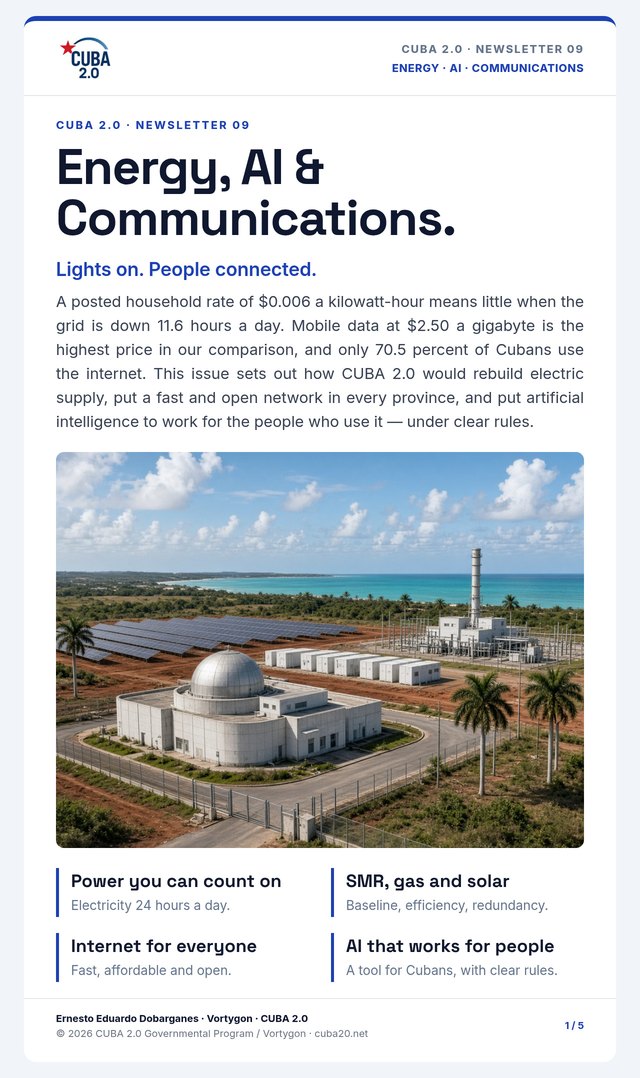
Reliable electricity is the foundation. A cheap, open network carries the work and the family traffic. Artificial intelligence extends what people can do with both.
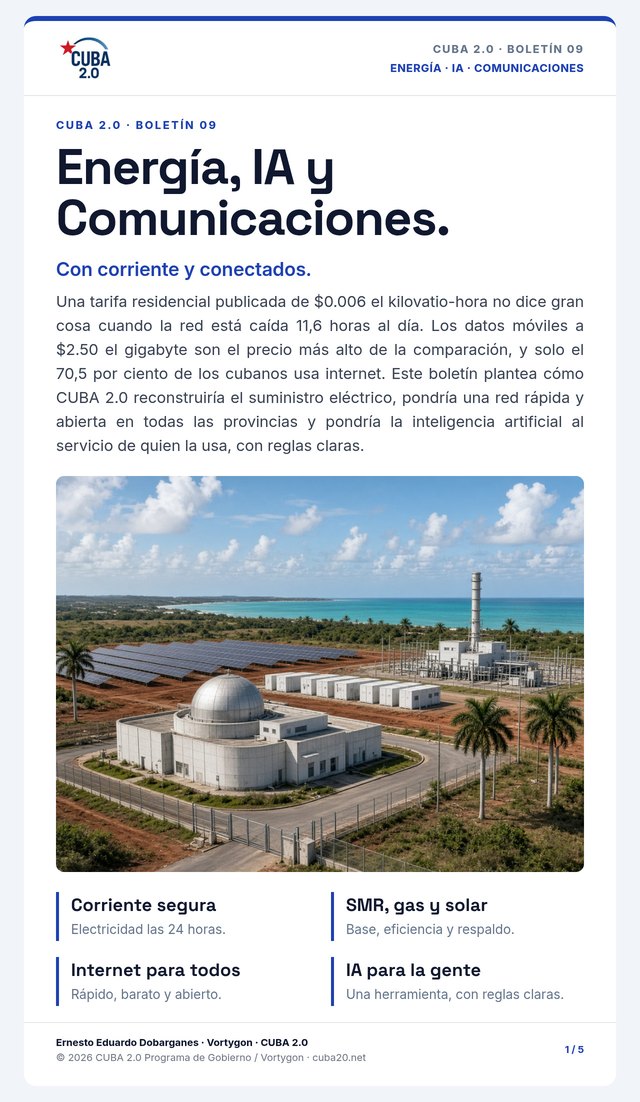
La electricidad confiable es la base. Una red barata y abierta transporta el trabajo y el tráfico familiar. La inteligencia artificial amplía lo que la gente puede hacer con ambas.
This issue takes up three parts of the CUBA 2.0 program that determine how a household, a hospital, a school or a business gets through the day: electricity, communications and artificial intelligence.
Este número aborda tres partes del programa CUBA 2.0 que deciden cómo atraviesa el día una casa, un hospital, una escuela o un negocio: la electricidad, las comunicaciones y la inteligencia artificial.
They are not separate files. A clinic’s tools are idle when the grid is down 11.6 hours a day. A family call is hard to hold when data costs $2.50 a gigabyte and the connection fails. What follows is the architecture for each, and the case for building them as one system.
No son expedientes aparte. Las herramientas de un policlínico quedan paradas cuando la red está caída 11,6 horas al día. Una llamada familiar es difícil de sostener cuando los datos cuestan $2.50 el gigabyte y la conexión se cae. A continuación va la arquitectura de cada una, y el argumento para construirlas como un solo sistema.
CUBA 2.0: lights on, people connected.CUBA 2.0: con corriente y conectados.
24 h
Electricity homes, hospitals, schools and businesses can rely on.
Electricidad con la que se pueda contar en casas, hospitales, escuelas y negocios.
Energy
Energía
SMR + gas + solar
SMR baseline, high-efficiency gas turbines and redundant solar with batteries.
SMR como base, turbinas de gas de alta eficiencia y solar redundante con baterías.
Energy
Energía
Internet
Fast, affordable and open, in every province.
Rápido, barato y abierto, en todas las provincias.
Communications
Comunicaciones
AI
A tool for Cubans, with clear rules that protect privacy and freedom of expression.
Una herramienta para los cubanos, con reglas claras que protejan la privacidad y la libertad de expresión.
Artificial intelligence
Inteligencia artificial
01 / 03 · ENERGY
01 / 03 · ENERGÍA
Power you can count on.
Corriente con la que se pueda contar.
Cuba’s official residential tariff is $0.006 per kilowatt-hour (0.72 CUP/kWh), the lowest figure in the comparison — well below the $0.112 paid in the Dominican Republic and the $0.203 average in the United States. The number on the tariff sheet is not the service in the house. From 6 October to 3 November 2026, the country averaged 11.6 hours a day without power. Families still plan the day around blackouts. Hospitals, schools and businesses cannot count on a full day’s current.
La tarifa residencial oficial de Cuba es de $0.006 por kilovatio-hora (0,72 CUP/kWh), la cifra más baja de la comparación: muy por debajo de los $0.112 que se pagan en la República Dominicana y de los $0.203 de promedio en Estados Unidos. El número de la tarifa no es el servicio en la casa. Del 6 de octubre al 3 de noviembre de 2026, el país promedió 11,6 horas al día sin corriente. Las familias siguen organizando el día alrededor de los apagones. Los hospitales, las escuelas y los negocios no pueden contar con un día completo de electricidad.
CUBA 2.0 would end that bargain of a low official price and an unreliable supply. The aim is the cheapest, most reliable and most abundant electricity possible, 24 hours a day, delivered through three layers on a modernized grid: small modular reactors (SMRs) for baseline capacity, high-efficiency gas turbines, and redundant solar with batteries. Until those layers actually deliver the kilowatt-hours, a rate of $0.006 is only a figure on paper.
CUBA 2.0 pondría fin a ese trato de un precio oficial bajo y un suministro poco confiable. El objetivo es la electricidad más barata, más confiable y más abundante posible, las 24 horas, a través de tres capas sobre una red modernizada: reactores modulares pequeños (SMR) como capacidad base, turbinas de gas de alta eficiencia y energía solar redundante con baterías. Mientras esas capas no entreguen de verdad los kilovatios-hora, una tarifa de $0.006 no es más que una cifra en el papel.
Power you can count on.Corriente con la que se pueda contar.
ENERGY · THE ARCHITECTURE
ENERGÍA · LA ARQUITECTURA
Three layers, one reliable supply.
Tres capas, un suministro confiable.
Homes built to produce the electricity they use.Casas construidas para producir la electricidad que consumen.
SMR baseline capacity: small modular reactors;
high-efficiency gas turbines;
redundant solar with batteries across the island.
Capacidad base con SMR: reactores modulares pequeños;
turbinas de gas de alta eficiencia;
energía solar redundante con baterías por toda la isla.
Each layer covers a weakness in the others. Reactors hold a steady baseline; turbines add efficient capacity as demand rises; solar and batteries, installed across the island, keep local supply available if a plant or a transmission line fails. The modernized grid is what makes the three work as one system rather than three isolated bets.
Cada capa cubre una debilidad de las otras. Los reactores sostienen una base estable; las turbinas aportan capacidad eficiente cuando sube la demanda; la solar y las baterías, instaladas por toda la isla, mantienen un suministro local si falla una planta o una línea de transmisión. La red modernizada es lo que hace que las tres funcionen como un solo sistema, y no como tres apuestas sueltas.
Housing is part of the same design. CUBA 2.0 will give priority to developments that generate their own power, following the model set out in Newsletter 08: homes built to produce the electricity they use. That does not replace the three-layer system. It shortens the distance between supply and the family that depends on it, and it keeps a household running when a feeder line goes down.
La vivienda forma parte del mismo diseño. CUBA 2.0 dará prioridad a los desarrollos que generen su propia electricidad, siguiendo el modelo planteado en el Boletín 08: casas construidas para producir la electricidad que consumen. Eso no sustituye el sistema de tres capas. Acorta la distancia entre el suministro y la familia que depende de él, y mantiene la casa en marcha cuando se cae una acometida.
Energy compared
COUNTRY
USD / kWh
OUTAGES
Cuba
$0.006
11.6 h/day
Dominican Republic
$0.112
n/a
Guatemala
$0.329
n/a
Costa Rica
$0.190
n/a
Colombia
$0.250
n/a
Jamaica
$0.296
n/a
Panama
$0.175
n/a
Mexico
$0.113
n/a
Puerto Rico
$0.258
n/a
United States
$0.203
n/a
Sources. Household electricity prices, GlobalPetrolPrices (March 2026), official residential tariffs including taxes and fees, except Puerto Rico, U.S. EIA Electric Power Monthly Table 8.4, 2026 year-to-date average through August (released 23 Oct 2026). Cuba outages, 11.6 hours/day national average without power, 6 Oct–3 Nov 2026, Cuba Clara, compiled from official UNE daily reports. Comparable current SAIDI or daily outage hours were not found for the other countries; marked n/a. Cuba’s $0.006/kWh is the official household rate as converted by GlobalPetrolPrices (0.72 CUP/kWh).
La energía comparada
PAÍS
USD / kWh
APAGONES
Cuba
$0.006
11,6 h/día
República Dominicana
$0.112
n/d
Guatemala
$0.329
n/d
Costa Rica
$0.190
n/d
Colombia
$0.250
n/d
Jamaica
$0.296
n/d
Panamá
$0.175
n/d
México
$0.113
n/d
Puerto Rico
$0.258
n/d
Estados Unidos
$0.203
n/d
Fuentes. Precios residenciales de electricidad, GlobalPetrolPrices (marzo de 2026), tarifas oficiales con impuestos y cargos, excepto Puerto Rico, U.S. EIA Electric Power Monthly, tabla 8.4, promedio acumulado de 2026 hasta agosto (publicado el 23 de oct. de 2026). Apagones en Cuba, 11,6 horas al día de media nacional sin servicio, del 6 de oct. al 3 de nov. de 2026, Cuba Clara, a partir de los partes diarios oficiales de la UNE. No se encontró un SAIDI o un dato de horas diarias comparable y actual para los demás países; se indica n/d. Los $0.006/kWh de Cuba son la tarifa residencial oficial convertida por GlobalPetrolPrices (0,72 CUP/kWh).
The table states the trade-off clearly. Peer residential prices range from $0.112 in the Dominican Republic to $0.329 in Guatemala. Cuba’s official $0.006 sits far below all of them, while 11.6 hours a day without power has no current counterpart in the same set. The gap to close is reliability, not a still-lower tariff.
La tabla deja claro el dilema. Los precios residenciales de los países comparables van de $0.112 en la República Dominicana a $0.329 en Guatemala. Los $0.006 oficiales de Cuba quedan muy por debajo de todos, mientras que 11,6 horas al día sin servicio no tienen un equivalente actual en el mismo conjunto. El desfase que hay que cerrar es el de la confiabilidad, no el de una tarifa todavía más baja.
The architecture is only as good as the current it delivers: the cheapest, most reliable and most abundant supply, 24 hours a day.La arquitectura vale lo que vale la corriente que entrega: el suministro más barato, más confiable y más abundante, las 24 horas.
02 / 03 · COMMUNICATIONS
02 / 03 · COMUNICACIONES
Internet for everyone.
Internet para todos.
Internet that is fast, affordable and open should be ordinary in every province — at home, at school, at the clinic and in the park. It is not. Mobile data in Cuba costs $2.50 per gigabyte, the highest rate in the comparison; among the other countries the range is $0.28 to $1.20. Paying the top price for a connection that keeps dropping is a bad bargain for any household.
Un internet rápido, barato y abierto debería ser lo normal en todas las provincias: en la casa, en la escuela, en el policlínico y en el parque. No lo es. Los datos móviles en Cuba cuestan $2.50 el gigabyte, la tarifa más alta de la comparación; en los demás países el rango va de $0.28 a $1.20. Pagar el precio más alto por una conexión que se cae a cada rato es un mal negocio para cualquier familia.
Close to family
Cerca de los suyos
For Cubans on the island and those living abroad, a stable video call is often how parents, children and grandparents stay in daily contact. That is difficult at $2.50 a gigabyte, on a line that fails mid-conversation. Bringing the price and the reliability into line with peer markets is not a convenience. It is the condition for family contact, and for work and study that now assume a connection will simply be there.
Para los cubanos de la isla y para los que viven fuera, una videollamada estable es a menudo la forma en que padres, hijos y abuelos se mantienen en contacto a diario. Eso es difícil a $2.50 el gigabyte, en una línea que se corta a media conversación. Alinear el precio y la confiabilidad con los mercados comparables no es una comodidad. Es la condición del contacto familiar, y de un trabajo y un estudio que ya dan por hecha una conexión.
A fast, affordable, open network in every province.Una red rápida, barata y abierta en todas las provincias.
COMMUNICATIONS · CONNECTED PLACES
COMUNICACIONES · LUGARES CONECTADOS
At home, at school, at the clinic and in the park.
En la casa, en la escuela, en el policlínico y en el parque.
An open network in every province has a concrete purpose:
Una red abierta en todas las provincias tiene un propósito concreto:
a student can take a course online;
a self-employed worker can sell to the world;
a family can video-call a relative abroad;
no one pays a fortune for a connection that keeps dropping.
un estudiante puede pasar un curso en línea;
un cuentapropista puede venderle al mundo;
una familia puede hacer una videollamada con el pariente que está afuera;
nadie paga un dineral por una conexión que se cae a cada rato.
Communications compared
COUNTRY
USD / GB
BROADBAND / MO
MOBILE Mbps
INTERNET %
Cuba
$2.50
n/a
n/a
70.5%
Dominican Republic
$0.51
$28.61
124.76
91.0%
Guatemala
$0.75
$41.73
65.15
60.2%
Costa Rica
$0.80
$53.85
71.30
87.2%
Colombia
$0.28
$21.84
47.55
79.3%
Jamaica
$0.32
$48.10
n/a
90.1%
Panama
$0.68
$31.00
39.58
72.8%
Mexico
$0.75
$37.74
47.74
83.1%
Puerto Rico
$1.20
$75.00
n/a
87.3%
United States
$0.60
$80.00
190.59
94.7%
Sources. Mobile data, Broadband Genie Global Mobile Data Price League 2026 (sampled 6–10 July 2026), average USD per GB. Fixed broadband, Broadband Genie Global Broadband Price League 2026 (sampled 27 Jan–10 Feb 2026), average monthly USD; Cuba was excluded from that study, n/a. Mobile download, Ookla Speedtest Global Index median, September 2026; Cuba, Jamaica and Puerto Rico, n/a (not reported). Internet users, World Bank / ITU, individuals using the Internet (% of population), 2024, except Puerto Rico, 2022.
Las comunicaciones comparadas
PAÍS
USD / GB
BANDA ANCHA / MES
MÓVIL Mbps
INTERNET %
Cuba
$2.50
n/d
n/d
70,5%
República Dominicana
$0.51
$28.61
124.76
91,0%
Guatemala
$0.75
$41.73
65.15
60,2%
Costa Rica
$0.80
$53.85
71.30
87,2%
Colombia
$0.28
$21.84
47.55
79,3%
Jamaica
$0.32
$48.10
n/d
90,1%
Panamá
$0.68
$31.00
39.58
72,8%
México
$0.75
$37.74
47.74
83,1%
Puerto Rico
$1.20
$75.00
n/d
87,3%
Estados Unidos
$0.60
$80.00
190.59
94,7%
Fuentes. Datos móviles, Broadband Genie Global Mobile Data Price League 2026 (muestra del 6 al 10 de julio de 2026), promedio en USD por GB. Banda ancha fija, Broadband Genie Global Broadband Price League 2026 (muestra del 27 de ene. al 10 de feb. de 2026), promedio mensual en USD; Cuba quedó fuera de ese estudio, n/d. Descarga móvil, mediana del Ookla Speedtest Global Index, septiembre de 2026; Cuba, Jamaica y Puerto Rico, n/d (no reportados). Usuarios de internet, Banco Mundial / UIT, personas que usan internet (% de la población), 2024, excepto Puerto Rico, 2022.
Cuba’s $2.50 per gigabyte stands alone at the top of the table. The next highest figure is Puerto Rico at $1.20; Colombia is $0.28. Internet use is 70.5 percent of the population — above Guatemala (60.2 percent), well short of the Dominican Republic (91.0 percent) and the United States (94.7 percent). The sources used here publish no Cuban figure for fixed broadband or for mobile download speed. Closing that gap means a connection that is fast, affordable and open in the places people already are, not a higher price for the same fragile service.
Los $2.50 por gigabyte de Cuba quedan solos en lo alto de la tabla. La cifra siguiente es Puerto Rico, a $1.20; Colombia está en $0.28. El uso de internet alcanza al 70,5 por ciento de la población: por encima de Guatemala (60,2 por ciento), bastante por debajo de la República Dominicana (91,0 por ciento) y de Estados Unidos (94,7 por ciento). Las fuentes usadas aquí no publican una cifra cubana de banda ancha fija ni de velocidad de descarga móvil. Cerrar esa brecha significa una conexión rápida, barata y abierta en los sitios donde ya está la gente, no un precio más alto por el mismo servicio frágil.
The network CUBA 2.0 is building has a single test: fast, affordable and open, in every province.La red que CUBA 2.0 propone tiene una sola prueba: rápida, barata y abierta, en todas las provincias.
03 / 03 · ARTIFICIAL INTELLIGENCE
03 / 03 · INTELIGENCIA ARTIFICIAL
AI that works for people.
Una IA que trabaje para la gente.
AI as a tool that supports doctors and teachers.La IA como herramienta que apoya a médicos y maestros.
Artificial intelligence belongs in this program only as a tool for the Cubans who will use it, and only once the grid and the network actually work. The uses below depend on that foundation, and on rules stated in advance that protect privacy and freedom of expression.
La inteligencia artificial entra en este programa solo como herramienta para los cubanos que la van a usar, y solo cuando la red eléctrica y la de comunicaciones funcionen de verdad. Los usos que siguen dependen de esa base, y de reglas planteadas de antemano que protejan la privacidad y la libertad de expresión.
to support doctors and teachers;
to make public paperwork faster and simpler;
to open new jobs and businesses;
with clear rules that protect privacy and freedom of expression.
para apoyar a médicos y maestros;
para que los trámites sean más rápidos y sencillos;
para abrir nuevos empleos y negocios;
con reglas claras que protejan la privacidad y la libertad de expresión.
Those uses are not independent of the rest of this issue. A tool for a doctor or a classroom is idle through 11.6 hours of blackout. A service that has to travel over $2.50-a-gigabyte data will not reach the households the program is written for. New jobs, faster paperwork and better public services appear only when the power stays on and the connection holds. The rules are the other half of the bargain: capability, with limits the public can see.
Esos usos no son independientes del resto de este boletín. Una herramienta para un médico o un aula queda parada durante 11,6 horas de apagón. Un servicio que tenga que circular sobre datos a $2.50 el gigabyte no va a llegar a los hogares para los que está escrito el programa. Los empleos nuevos, los trámites más rápidos y unos servicios públicos mejores aparecen solo cuando hay corriente y la conexión se sostiene. Las reglas son la otra mitad del trato: capacidad, con límites que la gente pueda ver.
AI can extend what a clinic, a school or a small business can do. It should serve the people who use it.La IA puede ampliar lo que hace un policlínico, una escuela o un pequeño negocio. Tiene que estar al servicio de quien la usa.
ENERGY · AI · COMMUNICATIONS
ENERGÍA · IA · COMUNICACIONES
It all goes together.
Todo va junto.
The last question is who builds and maintains these systems. CUBA 2.0 would train young Cubans to design and operate them — the plants, the networks, the software — not merely to use what arrives from abroad. That is the difference between a market for imported equipment and an economy that can staff its own energy, communications and public services.
La última pregunta es quién construye y mantiene estos sistemas. CUBA 2.0 formaría a jóvenes cubanos para diseñarlos y operarlos —las plantas, las redes, el software—, no solo para usar lo que llega de afuera. Esa es la diferencia entre un mercado de equipo importado y una economía capaz de dotar de personal su propia energía, sus comunicaciones y sus servicios públicos.
Reliable electricity is the base. An affordable, open network carries the work and the family traffic. Artificial intelligence extends what people can do with both. One program, so every Cuban, on the island and abroad, can work, learn and stay close to family.La electricidad confiable es la base. Una red barata y abierta transporta el trabajo y el tráfico familiar. La inteligencia artificial amplía lo que la gente puede hacer con ambas. Un solo programa, para que cada cubano, dentro y fuera de la isla, pueda trabajar, estudiar y estar cerca de los suyos.
Ask LISA anything about CUBA 2.0 — the program, investments and next steps: (727) 620-6584. Know someone who should read this? Forward this page or subscribe at cuba20.net.
Pregúntele a LISA lo que quiera sobre CUBA 2.0 — el programa, las inversiones y los próximos pasos: (727) 620-6584. ¿Conoce a alguien que debería leer esto? Reenvíe esta página o suscríbase en cuba20.net.
Part of the CUBA 2.0 program
Parte del programa CUBA 2.0
Two million modular homes in eight years, clear title, a National Housing Lotto and no property tax on the family home. Read the full program and its two phases.
Dos millones de viviendas modulares en ocho años, título claro, una Lotería Nacional de la Vivienda y ningún impuesto sobre la casa familiar. Lea el programa completo y sus dos fases.
Join institutional investors and strategic partners building the next major economic story in the Americas under the CUBA 2.0 governmental framework.
Únase a inversionistas institucionales y socios estratégicos que construyen la próxima gran historia económica en las Américas bajo el marco gubernamental de CUBA 2.0.
Confidential materials available to verified institutional and accredited investors only.
Materiales confidenciales disponibles solo para inversionistas institucionales y acreditados verificados.
Available for questions about the program, investments, and next steps.Disponible para preguntas sobre el programa, las inversiones y los próximos pasos.